©

Date
Aug 2026
Client
SCS
Industry
Precision Manufacturing
Timeline
2 months


The Challenge
Precision is difficult to prove in prose. An engineer needs to see the numbers before they will start a conversation.
The buyer here is a design engineer holding a drawing, a material and a tolerance. That visitor does not want adjectives. They want to know whether 0.025 mm wire in Nitinol is within reach, which process delivers it, and who to send the drawing to. The previous site described the company well enough, but it kept the specifics out of reach. Nothing could be checked, compared or configured, so every enquiry began from zero and the technical conversation only started once someone picked up the phone. For a manufacturer competing for larger medical and aerospace contracts, the first impression read smaller than the operation behind it.
The Solution
Markets and manufacturing processes given equal standing, so both kinds of visitor reach the right page in a single step.
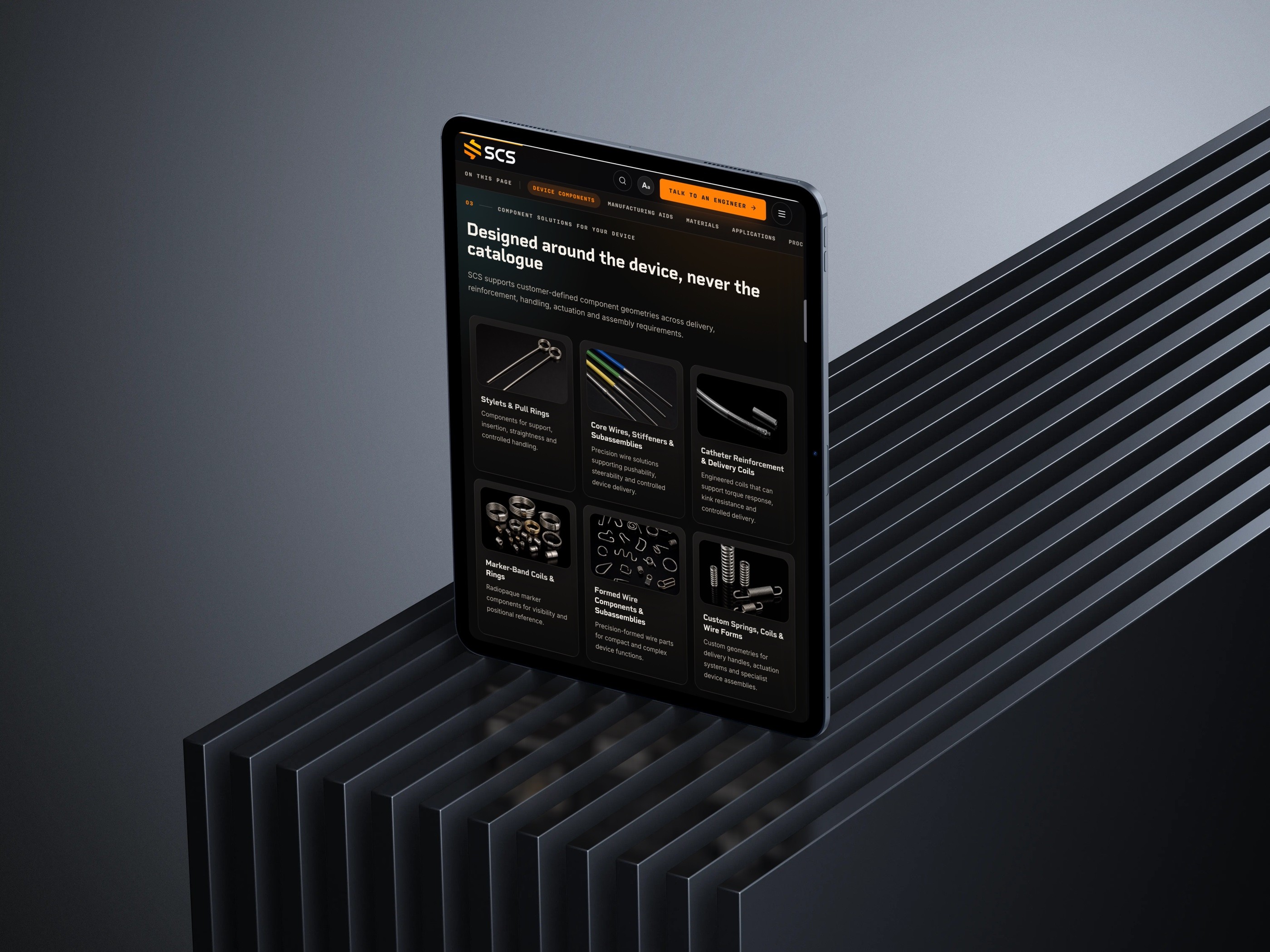
Medical, industrial and aerospace sit level with coiling, grinding, wire forming and value add. A device engineer arrives thinking about an application, a procurement lead arrives thinking about a process, and the navigation no longer asks either of them to guess. Component families are named the way they are actually specified: stylets and pull rings, core wires and stiffeners, catheter reinforcement and delivery coils, marker band coils and rings. Each capability page carries its own contents nav, its proven credentials and its materials list, so the technical depth is there without burying the route to an enquiry. Designed around the device, never the catalogue.

The Process
A configurator that turns a specification into an enquiry, before anyone has to pick up the phone.
Engineers configure a coil or a ground profile live on the page, setting geometry, material and dimensions against the real limits of the plant: 0.025 mm finest wire, plus or minus 0.002 mm tolerance, and coil outside diameters from 0.10 mm to 90 mm, in stainless steel, Nitinol, MP35N, titanium, platinum and precious alloys. A scale reference sets that finest wire against a pen nib, because a number that small means very little on its own. Every route then ends in the same place, a drawing upload or a direct line to an engineer, so the first message already carries the geometry, the material and the tolerance. That is what a quote actually needs, and it is the difference between an enquiry and a conversation that starts from zero.


By the numbers